




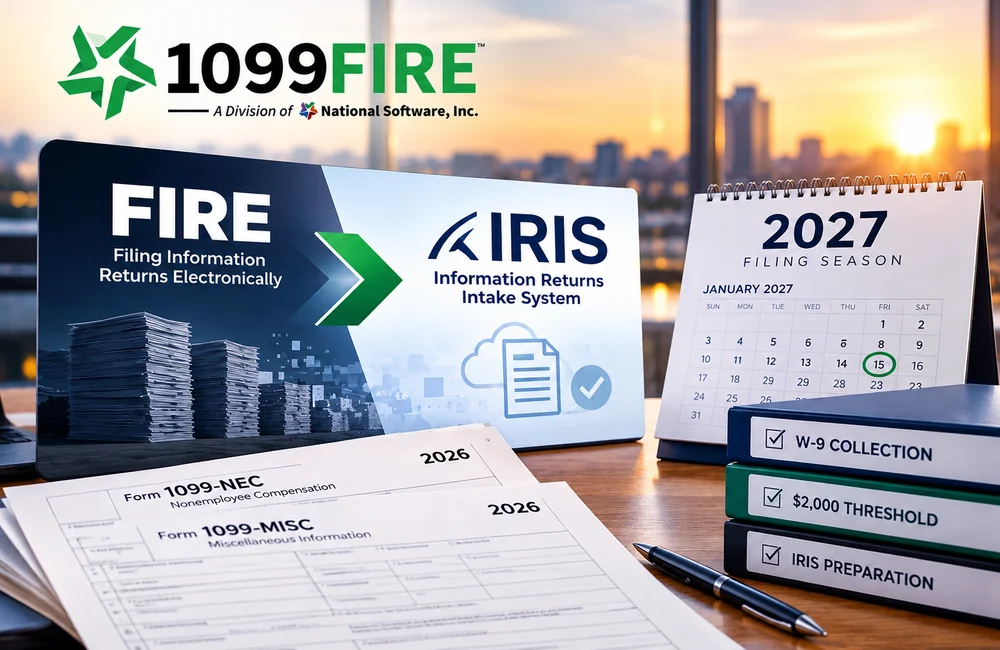
If your business files Forms 1099, the 2026 1099 filing changes are bigger than usual. Three developments land at once:
- The IRS is retiring FIRE, the electronic system many filers have used for decades.
- IRIS, the Information Returns Intake System, becomes the IRS intake system for those returns.
- The reporting threshold for many Form 1099-NEC and 1099-MISC payments rises from $600 to $2,000.
These changes apply to 2026 information returns, which most businesses file during the 2027 filing season. Each is manageable on its own, but together they’re easy to underestimate. Review your filing process before year-end, not in January.
Key Takeaways
Here’s what the 2026 1099 filing changes mean for your business:
- FIRE closes November 19, 2026, at 3 p.m. ET. After that, 2026 information returns, prior-year returns and corrections are filed through IRIS.
- Filing directly? You need an IRIS TCC. A FIRE TCC doesn’t carry over, and the IRS says approval takes about 45 business days. If a provider files for you under its own TCC, you don’t need one.
- The 1099-NEC threshold is now $2,000 for payments made in 2026, up from $600. Royalties, attorney gross proceeds and a few other payments keep their old thresholds.
- 2026 Forms 1099-NEC are due February 1, 2027, to both the IRS and recipients.
- Clean up your data now. Collect missing W-9s and check names and TINs before filing season, not in January.
2026 1099 Filing Changes at a Glance
| Change | What Businesses Need to Know |
|---|---|
| FIRE retirement | The final FIRE submission deadline is November 19, 2026, at 3 p.m. Eastern |
| IRIS transition | IRIS becomes the IRS intake system for information returns previously submitted through FIRE, including prior-year returns and corrections |
| New IRIS TCC | Businesses filing directly through IRIS need an IRIS Transmitter Control Code (TCC). A FIRE TCC doesn’t carry over |
| Reporting threshold | Certain payments previously subject to a $600 threshold move to $2,000 for payments made in 2026 |
| Data preparation | Review taxpayer names, TINs, classifications and the fields your filing method requires |
| Filing acknowledgments | Check the status of every submission and resolve anything rejected |
The IRS FIRE System Is Retiring in November 2026
For decades, FIRE (Filing Information Returns Electronically) was how businesses and filing providers sent Forms 1099, 1098, 5498 and W-2G to the IRS.
That ends this fall. The IRS confirmed the final milestones in IR-2026-99:
- November 1, 2026: last day for FIRE test submissions.
- November 9, 2026: last day to change an existing FIRE TCC application.
- November 19, 2026, at 3 p.m. ET: final day to submit anything through FIRE.
- Filing season 2027: IRIS replaces FIRE as the intake system for covered information returns.
According to Publication 1099, FIRE won’t accept current-year, prior-year or corrected returns once it shuts down. So a process built around FIRE files, FIRE credentials or a FIRE-based vendor won’t work in 2027 without changes.
One clarification. FIRE’s retirement doesn’t mean every IRS e-filing system is going away. ACA forms (1094-B, 1094-C, 1095-B and 1095-C) still go through the IRS AIR system, and Forms W-2 are still filed with the Social Security Administration.
What Changes When Filing Forms 1099 Through IRIS?
The forms themselves don’t change much. The way data reaches the IRS does. IRIS has its own registration, file formats and validation rules. For background on the system, see What is IRS IRIS?
New Filing Methods and TCC Requirements
IRIS offers two channels:
- IRIS Taxpayer Portal. A free IRS website where you enter returns by hand or upload them in batches using the IRS CSV template.
- IRIS Application to Application (A2A). Built for software and high-volume filers. Submissions are XML files built to the IRS schema, and anyone building a direct A2A connection must pass IRS testing.
If you plan to file directly, you need an IRIS TCC through the IRIS Application for TCC. Pub. 1099 says a typical application takes about 45 business days to process, so starting in December may be too late. Topic 802 explains how to apply. If a filing provider transmits your returns under its own TCC, you don’t need one.
More Structured Data and Submission Validation
IRIS uses defined data structures and checks submissions against them. Data that slipped through older processes may need cleanup. Pay close attention to:
- Payer and recipient information, with names and address parts in their proper fields
- Legal names and taxpayer identification numbers (TINs)
- Whether each recipient is an individual or a business
- Required fields and data formats for your filing method
- Duplicate records
- The correct form, box and payment amount
It helps to separate two kinds of checks. Technical validation asks whether the submission meets the IRS’s format and data rules. If it doesn’t, the submission can be rejected. IRS taxpayer matching is different. It compares names and TINs against IRS records, and problems often show up later as notices. A name and TIN that don’t match won’t necessarily stop a filing, but they can still cause trouble months afterward.
Filing Acknowledgments and Corrections
A successful transmission isn’t the same as an accepted return. After processing, IRIS assigns each transmission a status, such as Accepted, Accepted with errors, Partially accepted or Rejected. The IRS doesn’t keep rejected records, so they have to be fixed and sent again.
The move also changes how you handle originals, prior-year returns and corrections. After January 1, 2027, all of them go through IRIS, including corrections to returns you first filed through FIRE.
The 1099 Reporting Threshold Increases to $2,000 for 2026
For payments made in 2026, the general reporting threshold for payments reportable on Form 1099-NEC and several Form 1099-MISC categories rises from $600 to $2,000. The IRS reflects the change in its Instructions for Forms 1099-MISC and 1099-NEC. For more background, see our post on the 1099-NEC threshold increase.
| Tax Year | General Threshold for Applicable Payments |
|---|---|
| 2025 | $600 |
| 2026 | $2,000 |
| 2027 and later | $2,000, subject to applicable inflation adjustments |
Example: A business pays an independent contractor $1,500 during 2026. Assuming the payment is subject to the ordinary Form 1099-NEC threshold and no special reporting rule applies, that payment alone wouldn’t ordinarily require a Form 1099-NEC.
Some important distinctions:
- The $2,000 threshold isn’t universal. Royalties are still reportable at $10, gross proceeds paid to an attorney at $600, and direct sales of consumer products for resale at $5,000. Forms such as 1099-INT, 1099-DIV, 1099-R and 1099-K follow their own rules.
- Backup withholding changes the rule. If you withheld federal income tax under the backup withholding rules, you file regardless of the amount.
- Keep collecting W-9s. Get one during vendor onboarding, before you know how much you’ll pay.
- Keep accurate records. Several smaller payments can add up to $2,000, and recipients still owe tax on income that isn’t reported to them.
- Check your states. State requirements may differ from federal ones.
Why Accurate W-9 and TIN Information Matters During the IRIS Transition
New systems tend to expose old data problems. The cheapest time to fix a bad name or TIN is during vendor onboarding, not after an IRS notice.
- Get a W-9 during onboarding, before the first payment.
- Confirm the legal name. Line 1 of the W-9 is the name that has to match the TIN.
- Separate legal names from DBAs. A trade name alone often won’t match IRS records. For a sole proprietor, the owner’s name goes with their SSN or EIN.
- Review SSNs and EINs to make sure the number type fits the payee.
- Flag missing or invalid information early, while the vendor is still easy to reach.
- Use IRS TIN Matching to check name and TIN combinations against IRS records before you file. Our guide to IRS bulk TIN matching explains how it works and what the results mean.
TIN Matching is useful, but it has limits. It confirms whether a name and TIN combination matches IRS records. It doesn’t check payment amounts, whether you chose the right form, or every other part of filing compliance.
Here’s how the pieces connect. When the IRS finds name and TIN mismatches on filed returns, it may send the payer a CP2100 or CP2100A notice. That notice can start the B-notice process, where the payer asks the payee for a corrected TIN. If the payee doesn’t respond, backup withholding may apply to future payments. Not every mismatch leads to every one of these steps, and penalties aren’t automatic. For examples of common mismatch errors, see why the name and SSN must match the IRS database.
Want to catch discrepancies before filing? Learn how our TIN Matching service checks taxpayer names and TINs against IRS records.
How to Prepare for the 2026 1099 Filing Changes
Use the rest of 2026 to get ready. This list focuses on what’s new this year. For the full process, from W-9 collection to recipient delivery, see our 1099 filing checklist.
Before FIRE Retirement
- Identify any outstanding FIRE filings and corrections.
- Review the official IRS cutoff dates.
- Find out whether your current process, or your vendor’s, relies on FIRE.
- Confirm your organization’s IRIS transition plan.
Before December 31, 2026
- Collect missing W-9s.
- Review taxpayer names and TINs.
- Reconcile payments by payee.
- Identify which payments meet the new thresholds.
- Confirm vendor classifications.
- Decide who will handle filing and what resources they need.
Before Submitting 2026 Forms 1099
- Confirm the correct filing method.
- Review the IRIS credentials you need if you’re filing directly.
- Validate payer and recipient data.
- Confirm form-specific IRS and recipient deadlines. Form 1099-NEC, for example, is due to both the IRS and recipients by February 1, 2027, since January 31 falls on a Sunday.
- Review applicable state requirements.
- Set up a process for checking filing acknowledgments.
After Submission
- Confirm IRS processing results. See how to check your IRIS filing status.
- Address rejected submissions.
- Make any necessary corrections.
- Keep appropriate records of what you filed.
- Document how and when recipient copies were delivered.
Should Your Business Manage IRIS Filing Internally or Outsource It?
The right approach depends on your volume, your team and how much of the transition you want to manage yourself.
| Approach | Considerations |
|---|---|
| File directly through IRS IRIS | Requires an IRIS TCC, familiarity with the filing process and internal resources |
| Use third-party filing software | May simplify preparation but still requires vendor selection, setup and oversight |
| Outsource 1099 filing | A service provider handles agreed-upon filing tasks, reducing your team’s workload |
Outsourcing makes sense for businesses that would rather not manage system changes, data preparation, submission monitoring and recipient delivery entirely in-house.
1099FIRE has more than 20 years of experience with information returns and files through IRIS under its own IRS-approved A2A credentials. Clients upload data to our secure portal, where it’s checked as it comes in, and nothing is filed until they approve PDF copies of their forms. Clients don’t need their own TCC or ID.me account, and printing and mailing recipient copies is available as an add-on.
Explore our outsourced 1099 filing services to see how the process works.
FAQs About the 2026 1099 Filing Changes
When is the IRS FIRE system shutting down?
The final day to submit through FIRE is November 19, 2026, at 3 p.m. ET. For filing season 2027, current-year returns, prior-year returns and corrections that used to go through FIRE are filed through IRIS.
Do I need a new TCC to file through IRIS?
If you file directly, yes. A FIRE TCC doesn’t work in IRIS, so you need to complete the IRIS Application for TCC. If a filing provider submits under its own TCC, you don’t need one.
What is the Form 1099-NEC reporting threshold for 2026?
The general threshold is $2,000 for payments made in 2026, up from $600. Some payments keep different thresholds. Royalties, for example, are still reportable at $10 on Form 1099-MISC.
Can prior-year 1099 returns and corrections be submitted through IRIS?
Yes. After January 1, 2027, IRIS handles prior-year returns and corrections, including corrections to returns originally filed through FIRE. Check current IRS procedures before you file: Publication 5717 covers the Taxpayer Portal and Publication 5718 covers A2A.
Will IRS TIN Matching guarantee that my filing is accepted?
No. TIN Matching is an important data-quality check, but it only confirms name and TIN combinations. It doesn’t confirm the form or amounts, and a submission can still be rejected for other reasons.
Prepare Now for the 2027 Filing Season
Three points to take away from the 2026 1099 filing changes:
- FIRE’s retirement means your electronic filing process has to change.
- The new $2,000 threshold changes which payments you report, but not every form follows it.
- Accurate taxpayer data and early preparation make filing season smoother.
Need help preparing for the 2027 filing season? Contact us or call (480) 706-6474 to discuss your filing needs.