




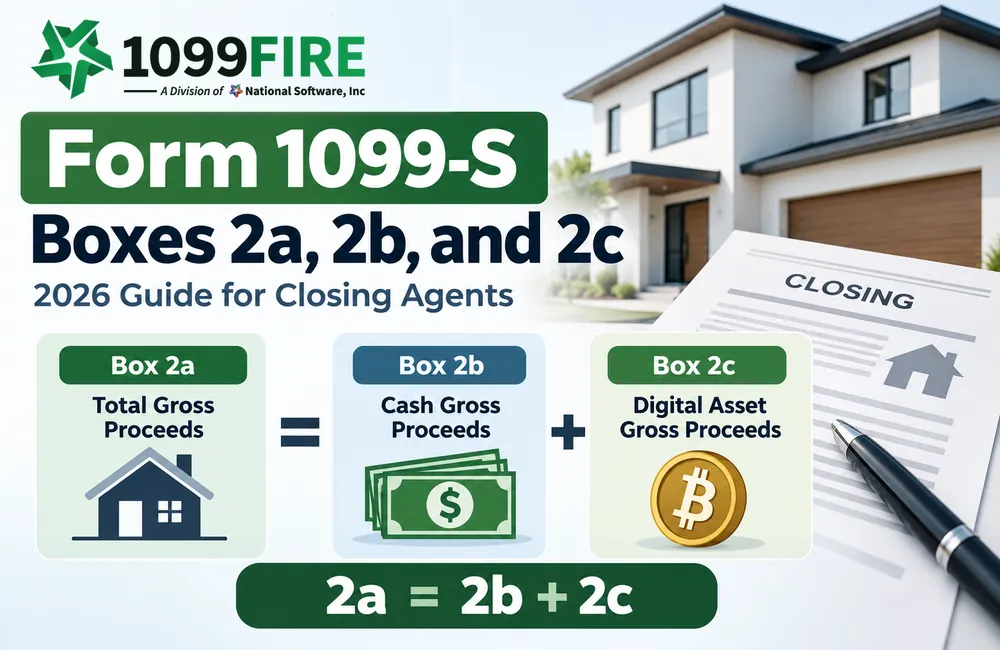
The 2026 Form 1099-S splits gross proceeds into three boxes. Box 2a is the total, box 2b is the cash portion and box 2c is the value of any digital assets the seller received. The change applies to real estate closings in tax year 2026, and you’ll file those returns with the IRS in early 2027.
If you close transactions for a title company, escrow office or law firm, the new layout affects how you collect closing data. This guide explains how to report Form 1099-S gross proceeds in each Box 2 field, with worked examples and a checklist you can use before year-end.
Key Takeaways
- Box 2a, total gross proceeds, always equals box 2b plus box 2c.
- Seller notes, assumed mortgages and loans paid off at closing count as cash in box 2b.
- Crypto the seller actually receives goes in box 2c at its U.S. dollar value. Crypto a payment processor converts to dollars first is cash.
- Commissions, legal fees and other selling costs never reduce gross proceeds.
- Boxes 8a through 8d identify any digital asset received.
- Recipient statements for 2026 closings are due February 16, 2027, because February 15 is a federal holiday.
Quick Answer: What Changed in 2026 Form 1099-S Box 2?
Before 2026, Form 1099-S had a single Box 2 for gross proceeds. Starting with tax year 2026, the IRS reports digital assets used in real estate sales on Form 1099-S, so the form now separates cash from digital assets.
| Old form | 2026 form |
|---|---|
| Box 2: Gross proceeds | Box 2a: Total gross proceeds |
| (included in Box 2) | Box 2b: Cash gross proceeds |
| Not reported | Box 2c: Digital asset gross proceeds |
| Not reported | Boxes 8a to 8d: Code, name, units and date of the digital asset received |
The math is simple: box 2a = box 2b + box 2c. For most closings, where the seller receives no crypto, box 2c is zero and box 2a equals box 2b.
Other boxes moved too. On the 2026 form, the buyer’s part of real estate tax is box 4, box 5 is reserved, box 6 is the check box for services or property received, and box 7 flags a foreign transferor. If your import file or closing software maps fields by box number, update it. Our article on 2026 Form 1099 box changes covers the other forms that changed.
Form 1099-S Gross Proceeds Versus Taxable Gain
Form 1099-S gross proceeds aren’t the seller’s profit. They’re generally the sales price: the total consideration the seller received or will receive for the real estate. The seller works out gain or loss on their own return.
That’s why the IRS says not to reduce gross proceeds by the seller’s expenses. Sales commissions, deed preparation, advertising and legal fees all stay in the number. A $500,000 sale with $30,000 in seller-paid commissions still shows $500,000.
Box 2a: Total Gross Proceeds
Box 2a holds the total gross proceeds from the transaction, generally the sales price. Under the IRS instructions, it includes:
- Cash received, including cash from a processor of digital asset payments.
- Consideration treated as cash, such as notes and assumed liabilities.
- The U.S. dollar value of any digital asset received by or for the seller.
It doesn’t include the value of other property or services the seller receives. If the buyer pays part of the price that way, check box 6 instead. Cash that’s separately stated for personal property, like appliances or draperies, also stays out.
Box 2b: Cash Gross Proceeds
Box 2b covers cash and anything the IRS treats as cash. That reaches further than the check at closing:
- Cash at settlement. Funds paid to or for the seller.
- Seller-financed notes. The stated principal of a note payable to the seller.
- Mortgages paid off at settlement. A note or mortgage paid off at closing is part of cash proceeds.
- Assumed liabilities. If the buyer assumes the seller’s debt or takes the property subject to it, that liability counts as cash.
- Digital asset payment processors. If a processor turns the buyer’s crypto into dollars before the seller gets it, the seller received cash.
- Contingent payments. When part of the price depends on future events, report the maximum determinable proceeds, the most the seller could receive if every contingency is met.
Box 2c: Digital Asset Gross Proceeds
Box 2c is for digital assets the seller received, or will receive, as payment. The IRS defines a digital asset as a digital representation of value recorded on a cryptographically secured distributed ledger. Cryptocurrency and stablecoins are the common examples.
Valuing Digital Assets
Report the fair market value in U.S. dollars of the digital asset actually received. If the buyer promises to deliver crypto after closing, include the value of that obligation, measured when the parties enter into it.
Boxes 8a Through 8d
When box 2c has an amount, describe the asset in boxes 8a to 8d:
- Box 8a: The nine-character alphanumeric Digital Token Identifier Foundation (DTIF) code. If the asset is not registered, enter 999999999.
- Box 8b: The asset’s full name, matching the DTIF registration if you used a code.
- Box 8c: The number of units, to as many as 18 decimal places.
- Box 8d: The date received, in MM/DD/YYYY format. Leave it blank if units arrived on several dates.
When You’re Expected to Know
You report digital asset details when you know, or ordinarily would know, that the seller received digital assets as payment. If the purchase contract calls for payment in digital assets, the IRS treats you as knowing. Read the contract before you finalize box 2.
Practical Reporting Examples
We’ve simplified these examples, so always apply the full IRS instructions to the facts of your closing.
Example A: Cash and Cryptocurrency
A property sells for $540,000. The buyer pays $500,000 in cash at closing and transfers cryptocurrency worth $40,000 directly to the seller’s wallet. Box 2b shows $500,000, box 2c shows $40,000 and box 2a shows $540,000. Boxes 8a to 8d describe the crypto. If the buyer had paid through a processor that delivered dollars to the seller, all $540,000 would be cash in box 2b.
Example B: Seller Financing and an Assumed Mortgage
The buyer pays for a $400,000 property with $80,000 cash at closing, a $200,000 note payable to the seller and an assumption of the seller’s $120,000 mortgage. All three count as cash, so box 2b and box 2a both show $400,000 and box 2c is $0. The seller’s $24,000 commission doesn’t change the figure.
Example C: Two Unrelated Sellers
Two unrelated co-owners sell a property for $600,000. At closing, they provide a complete allocation of 70% and 30%. You file a separate Form 1099-S for each seller, showing $420,000 and $180,000. Written confirmation is good practice, but the IRS does not require an allocation request or response to be in writing. If you receive no allocation or the allocations conflict, generally report the full unallocated proceeds on each seller’s form.
| Example | Box 2a | Box 2b | Box 2c |
|---|---|---|---|
| A: Cash and crypto | $540,000 | $500,000 | $40,000 |
| B: Note and assumed mortgage | $400,000 | $400,000 | $0 |
| C: Seller 1 (70%) | $420,000 | $420,000 | $0 |
| C: Seller 2 (30%) | $180,000 | $180,000 | $0 |
Special Situations and Reporting Exceptions
Two questions come up at every closing. Does this sale need a Form 1099-S at all? And if it does, what goes in box 2? Answer them in that order.
Multiple Sellers, Spouses and Partnerships
- For multiple unrelated sellers, request an allocation at or before closing. An oral response can qualify; retain written confirmation when practical. If you receive no allocation or a conflicting one, generally report the unallocated amount on each affected transferor’s form.
- The IRS generally treats spouses who jointly own the property as one transferor, so one form is sufficient when they are the only sellers. An uncontested allocation can instead support separate forms.
- A partnership gets one Form 1099-S, not one per partner.
Common Exceptions
Under the IRS instructions, you generally don’t file Form 1099-S for:
- A principal residence sold for $250,000 or less ($500,000 or less if the seller certifies being married), when each seller provides an acceptable signed certification establishing the applicable section 121 conditions, including that the entire gain is excludable and there was no disqualifying nonqualified use. The sale amount alone does not establish an exception.
The seller signs an acceptable certification under penalties of perjury. The filer generally must retain it for four years after the sale year. If you don’t obtain the required certification, you must still report the sale, even when its price falls below the listed amount.
- Transactions under $600. That test applies to the whole transaction, not to each seller.
- Sales where the seller is a corporation or a governmental unit.
- Transfers in full or partial satisfaction of a debt secured by the property, such as foreclosures.
- Transfers that aren’t sales or exchanges, such as gifts and bequests.
Who Is Responsible for Filing
The person responsible for closing files the form. If a Closing Disclosure names a settlement agent, that’s the filer. Otherwise, the IRS sets an order that starts with the buyer’s attorney. The parties can also designate the filer in a written agreement at or before closing, as long as only one person files for each seller.
Closing-to-Filing Preparation Checklist
- Confirm who is responsible for filing, and put any designation agreement in writing.
- Request each seller’s TIN no later than closing, with a certification. Form W-9 works for U.S. persons.
- Review the purchase contract and Closing Disclosure for every form of payment.
- List all consideration: cash, notes, payoffs, assumed debt, digital assets, property and services.
- Record the U.S. dollar value, units, name and DTIF code of any digital asset received.
- Request the proceeds allocation for multiple sellers and keep a written record when practical; writing is recommended, not required by the IRS.
- Check that box 2a equals box 2b plus box 2c for every form.
- Plan how you’ll deliver seller statements, either at closing or by the deadline.
- Count your information returns. Filing 10 or more in the aggregate generally requires electronic filing, subject to applicable exceptions and waivers.
2026 Form 1099-S Deadlines
| Requirement | Due date for 2026 closings |
|---|---|
| Statement to the seller | February 16, 2027 (February 15 is Presidents Day) |
| Paper filing with the IRS | March 1, 2027 (February 28 is a Sunday) |
| Electronic filing with the IRS | March 31, 2027 |
The seller-statement, paper and electronic dates apply the IRS’s February 15, February 28 and March 31 rules, with next-business-day adjustments for holidays and weekends. You may also furnish the seller’s statement at closing. File tax year 2026 electronic Forms 1099-S through the IRS Information Returns Intake System (IRIS). Read more in 2026 Form 1099 filing changes. The IRS’s final FIRE filing cutoff is November 19, 2026, at 3 p.m. ET; FIRE will not accept 2026 returns filed in 2027.
How Outsourcing Form 1099-S Filing Can Help
Outsourcing works best when everyone knows their part. You supply accurate closing data, answer questions about each transaction and approve your forms before they’re filed. We handle the filing.
With 1099FIRE, clients upload their closing data to our secure client portal. The portal checks required submission fields as data is uploaded; clients resolve flagged errors and approve a PDF proof. After approval, we electronically file through IRIS and can print and mail seller copies. Clients do not need their own IRIS Transmitter Control Code to use our outsourced filing service.
For current filing data requirements and service details, contact our 1099FIRE team before preparing your upload.
Need Help Filing Forms 1099-S for 2026?
1099FIRE provides outsourced 1099 filing services for businesses and reporting professionals. Contact our U.S.-based team to talk through your filing requirements.
Frequently Asked Questions
What is the difference between Boxes 2a, 2b, and 2c?
Box 2a is total gross proceeds. Box 2b is the cash portion, including amounts treated as cash. Box 2c is the U.S. dollar value of digital assets the seller received. Box 2a always equals 2b plus 2c.
Are real estate commissions deducted from gross proceeds?
No. Commissions, deed preparation, advertising and legal fees paid by the seller don’t reduce gross proceeds.
How is cryptocurrency reported on Form 1099-S?
If the seller receives crypto directly, report its fair market value in U.S. dollars in box 2c and describe it in boxes 8a to 8d. If a payment processor converts it to dollars before the seller receives it, it’s cash in box 2b.
What if the buyer assumes the seller’s mortgage?
An assumed mortgage, or property taken subject to a mortgage, counts as cash. Include it in box 2b and box 2a.
How are proceeds allocated between multiple sellers?
Request a complete allocation from the transferors at or before closing; the IRS does not require the request or reply to be written. Generally, a separate Form 1099-S reports each unrelated transferor’s allocated proceeds. If you receive no allocation or the responses conflict, report the full unallocated proceeds for each affected transferor. Jointly owning spouses are generally treated as a single transferor.
What are the 2027 deadlines for reporting 2026 transactions?
Seller statements are due February 16, 2027. Paper returns are due March 1, 2027, and electronic returns are due March 31, 2027.
IRS references: Form 1099-S instructions | Form 1099-S | 2026 Pub. 1099